Source Foldable Hexacopter Agricultural Sprayer Uav for Crop Spraying, Pest Control, Fertilizer Spreading
Find 21 foldable hexacopter agricultural sprayer uav units with customizable payloads and flight times. Compare specifications including battery types, nozzle quantities, and GPS navigation systems from verified manufacturers in China.
Key considerations
Products List


Comprehensive Sourcing Guide
Foldable Hexacopter Agricultural Sprayer Uav Sourcing Guide
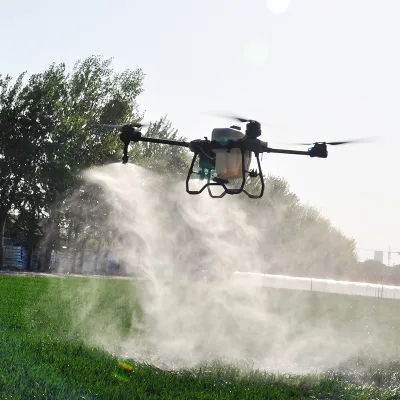
The foldable hexacopter agricultural sprayer UAV represents a specialized class of unmanned aerial vehicle designed to optimize crop protection and fertilizer distribution through high-precision electric spray systems. These units typically integrate high-efficiency brushless motors with intelligent lithium batteries to ensure reliable operation in demanding field conditions, offering flight times ranging from 10 to 25 minutes depending on the specific load and configuration. Buyers should recognize that these machines are engineered for applications such as crop spraying, pest control, and fertilizer spreading, where the ability to navigate complex terrain and maintain consistent spray patterns is critical for operational success.
Procurement of these systems requires careful attention to the modular design and assembly methods, as many models support tool-free assembly and foldable arm structures to facilitate compact transport and storage. The observed market data indicates a diverse range of configurations, including quadcopter, hexacopter, and octocopter rotor setups, with payload capacities varying significantly from 5 to 80 kilograms. This variability means that a single procurement strategy must account for specific operational needs, such as whether the primary requirement is a lightweight unit for small plots or a heavy-lift hexacopter capable of handling larger volumes of liquid disinfectors or medicines.
Product Scope and Observed Listing Signals
When evaluating product listings, buyers must distinguish between general sprayer parts and complete agricultural drone systems, as the market data reveals a mix of components and fully integrated units. The observed listings highlight specific attributes such as external thread connections for liquid containment and spraying shapes defined as sectors, which are essential for understanding the fluid dynamics of the application system. It is crucial to verify whether the listed item includes the full flight control suite, including GPS/GNSS navigation with optional RTK capabilities, or if it is merely a component like a nozzle or motor intended for integration into a larger system.
The commercial signals in the market show a wide price range from 230 to 14,000 USD, reflecting the disparity between basic parts and advanced, fully equipped hexacopters with high-precision spray systems. Minimum order quantities (MOQ) are frequently observed at 1 unit, suggesting that suppliers are willing to accommodate single-unit purchases for testing or small-scale deployment, though this may vary based on customization requests. Buyers should scrutinize the listed specifications for model numbers such as 6-10-14 or 4-50-101, as these codes often correlate with specific payload capacities, battery configurations, and frame materials like carbon fiber composite or aluminum alloy.
Technical Specifications to Verify
Verification of the flight control and navigation systems is paramount, as the operational effectiveness of a hexacopter depends heavily on its ability to maintain stable flight modes including manual, GPS, and auto-route flight. Buyers must confirm the specific control distance capabilities, which can extend up to 3-5 kilometers, and ensure the return-to-home functions are robust enough to handle low battery and signal loss scenarios without compromising crop coverage. The navigation system should ideally support GPS/GNSS with optional RTK for centimeter-level accuracy, which is necessary to achieve the observed spraying accuracy of ±5% and prevent overlapping or missed areas during application.
The physical and mechanical specifications of the frame and propulsion system require detailed scrutiny to ensure durability and efficiency under load. The frame material is often a combination of carbon fiber and aluminum alloy, providing a balance of strength and weight reduction, with maximum takeoff weights ranging from 25 to 120 kilograms depending on the model. Prospective buyers should verify the motor type, ensuring they are high-efficiency brushless motors paired with foldable, high-strength propellers that can withstand wind resistance up to Level 5 and operate within temperature ranges of -10°C to +45°C. Additionally, the flow rate of the spray system, typically between 1.5 and 3.0 liters per minute, must be matched to the specific crop requirements and nozzle quantity, which is often configurable between 2 and 4 nozzles.
Compliance and Safety Documentation
While specific certification statuses are not universally listed in the provided data, buyers must demand comprehensive documentation regarding the electrical and mechanical safety of the UAV systems. The presence of intelligent lithium batteries and high-voltage electric power supplies necessitates verification of compliance with international transport and storage standards for hazardous materials, particularly when shipping units containing high-capacity power sources. Procurement teams should request test reports or safety data sheets that confirm the battery management systems are designed to prevent thermal runaway and that the electrical components meet relevant industry safety standards for agricultural machinery.
Regulatory compliance extends beyond the hardware to include the operational authorization required for agricultural UAVs in the target market. Buyers should verify that the supplier provides documentation supporting the drone's registration and operational permissions, including any specific requirements for the use of GPS/GNSS systems and automated flight modes. Although the product origin is listed as China, the end-user must ensure that the specific model meets local aviation authority regulations regarding maximum takeoff weight, flight altitude, and no-fly zones, as these legal frameworks vary significantly by region and can impact the immediate deployability of the purchased equipment.
Cost Drivers and Commercial Terms
The total cost of ownership for a foldable hexacopter agricultural sprayer is driven by several key factors, including the complexity of the frame material, the capacity of the intelligent lithium battery, and the sophistication of the navigation system. Units featuring carbon fiber composite frames and high-precision electric spray systems with RTK capabilities will command a premium price compared to those with standard aluminum frames and basic GPS navigation. Buyers should analyze the trade-off between initial acquisition costs and long-term operational efficiency, as higher payload capacities and longer flight times can significantly reduce the time required to treat large agricultural areas.
Commercial terms regarding customization and branding support are also critical cost drivers, as the market data indicates that many suppliers offer OEM and ODM services with customizable product standards and colors. The ability to tailor the product model, such as selecting specific overall dimensions or folded transport sizes, can influence the final price and lead time. Buyers should negotiate clear terms regarding the manufacturing type, ensuring that factory-direct pricing is applied, and clarify the scope of the customization, including whether the branding support extends to software interfaces or physical casing modifications.
Supplier Qualification and Quality Control
Supplier qualification should focus on the manufacturing capabilities and the extent of their customization support, as the observed data highlights a strong emphasis on factory-direct production and modular design. Buyers must verify that the supplier has a proven track record in producing foldable hexacopters with tool-free assembly methods, as this indicates a mature manufacturing process that reduces the risk of assembly errors and ensures consistent quality across units. The availability of color options and branding support suggests a flexible production line, but buyers should confirm that these customizations do not compromise the structural integrity of the carbon fiber or aluminum alloy frame.
Quality control protocols must be rigorously defined to ensure that the delivered units meet the specified performance metrics, such as the maximum payload of 5-80 kilograms and the flight time of 15-25 minutes. Buyers should request evidence of quality assurance processes, including pre-shipment testing of the brushless motors, propellers, and spray systems to verify flow rates and spraying accuracy. It is essential to establish clear acceptance criteria for the product standard, which may be customized, and to define the procedures for handling defects or performance deviations, ensuring that the supplier is accountable for the reliability of the high-efficiency systems.
Long-Term Procurement Checks
Sustained procurement success relies on establishing a robust supply chain for spare parts and consumables, particularly for high-wear components like propellers, nozzles, and batteries. Buyers should verify the availability of replacement parts for the specific model, such as the 6-10-14 or 4-50-101, and confirm the lead times for restocking critical items to minimize downtime during the growing season. The modular design of these drones facilitates easier maintenance, but the long-term viability of the operation depends on the supplier's ability to provide a steady stream of compatible components and technical support.
Future-proofing the procurement strategy involves monitoring the evolution of navigation and spray technologies to ensure the purchased units remain competitive. As the industry moves toward more advanced RTK systems and higher payload capacities, buyers should negotiate upgrade paths or trade-in options with their suppliers to maintain operational efficiency. Additionally, the supplier's commitment to continuous improvement, evidenced by their support for customized standards and flexible production methods, will be a key indicator of their ability to adapt to changing agricultural needs and regulatory environments over the long term.
FAQs
What is the maximum takeoff weight for this foldable hexacopter agricultural sprayer uav?
The maximum takeoff weight ranges from 25 to 120 kg depending on the specific model configuration. This capacity allows for payloads between 5 and 80 kg, making it suitable for heavy-duty crop spraying and fertilizer spreading applications in agricultural settings.
How long does the battery last during a single flight with full load?
Flight time typically lasts between 10 and 15 minutes when operating under a full load condition. Depending on the specific payload and environmental factors, general flight time can extend up to 25 minutes, ensuring efficient coverage for standard agricultural spraying tasks.
Can the frame material withstand harsh outdoor operating temperatures?
Yes, the frame is constructed from carbon fiber composite and aluminum alloy for durability. The system is designed to operate reliably in temperatures ranging from -10°C to +45°C, ensuring consistent performance across various seasonal and climatic agricultural environments.
What navigation and control distance features are included in the sprayer?
The unit features GPS and GNSS navigation with optional RTK for high-precision accuracy. It supports a control distance of up to 3 to 5 km and includes automatic return-to-home functions triggered by low battery or signal loss, enhancing operational safety.
Is customization available for the drone's branding and specifications?
Customization is available for both branding and technical specifications. Buyers can select from OEM or ODM branding support and choose from color options like black or orange. The modular design allows for tool-free assembly and customizable overall dimensions to meet specific needs.
What spraying accuracy and flow rate can be expected from this system?
The high-precision electric spray system delivers a spraying accuracy of plus or minus 5 percent. The flow rate ranges from 1.5 to 3.0 liters per minute, with optional nozzle quantities of 2 to 4, allowing for precise application of disinfectants or medicines.